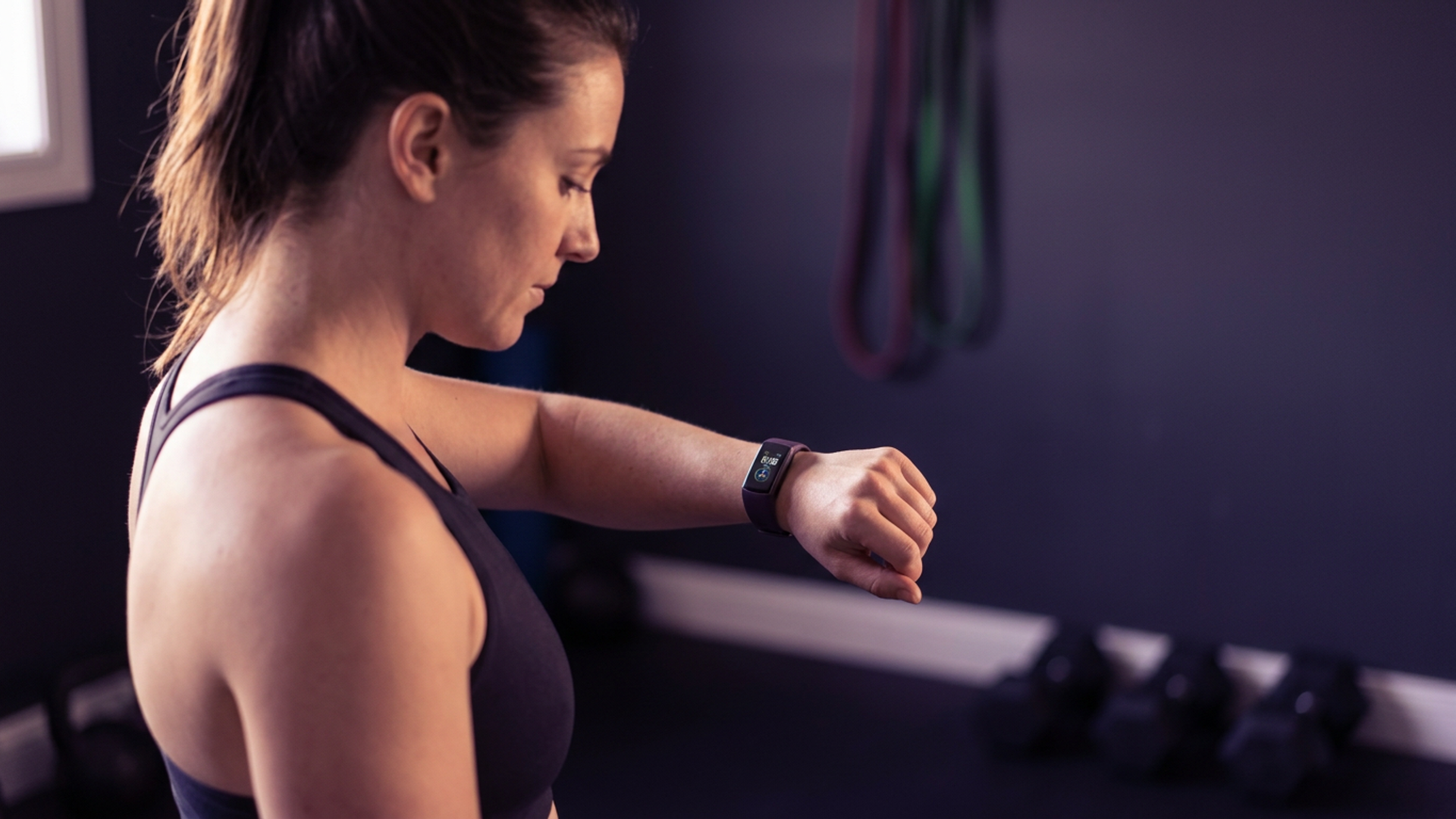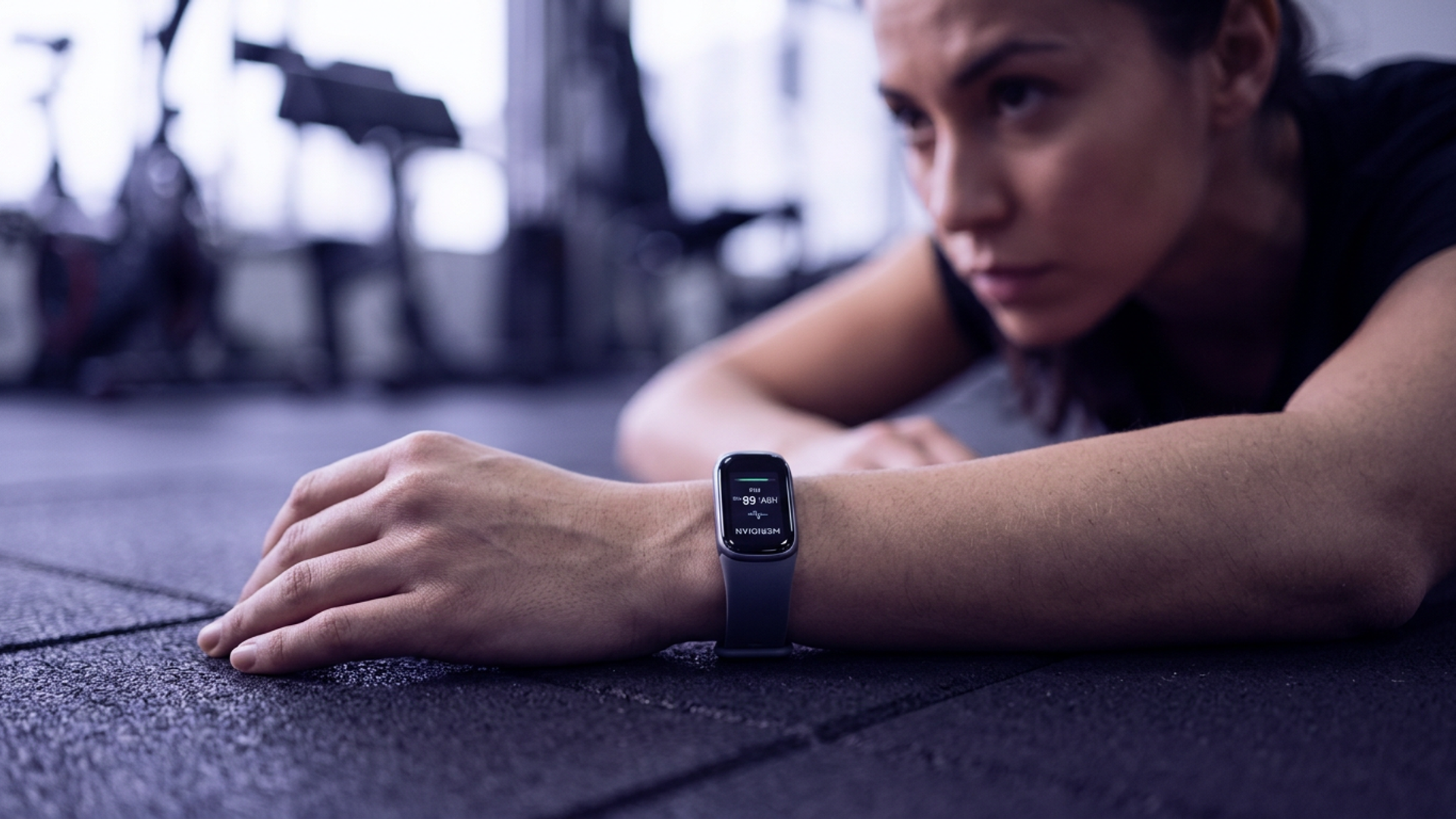
If you are optimising training load, the two numbers that matter most are HRV and sleep stages. Together they tell you whether your body is absorbing stress or just accumulating it. The Meridian Band tracks both continuously, starting at $179, with no mandatory subscription.
What HRV actually tells you
HRV stands for heart rate variability. It measures the time gap between heartbeats, not the beats per minute. A high HRV means the gaps are uneven in a healthy way. Your nervous system is actively regulating rhythm, balancing sympathetic and parasympathetic input. A low HRV means those gaps are rigid. Your body is under load.
That load can be physical: a hard interval session, a heavy lift. It can also be psychological: poor sleep, travel, a stressful work week. HRV does not distinguish the cause. It just shows the result. That is what makes it useful.
The critical thing to understand: your HRV only means something compared to your own baseline. According to Lifehacker, citing Whoop's data, the middle 50% of 20-year-olds have an HRV between about 60 and 105, with numbers declining with age. But comparing yourself to that range matters less than watching your own 7-day or 30-day trend. A drop from your normal is the signal.
Meridian tracks HRV overnight and surfaces a recovery score in the morning. With Insights Pro, that score gets context: your trend line over the past 30 days, what changed in the last 48 hours, and what the numbers suggest about your training readiness.
Why sleep stages matter for recovery
Total sleep hours is a blunt metric. Eight hours of mostly-light sleep is not the same as six hours with substantial deep and REM. The two stages do different things.
Deep sleep (slow-wave sleep) is when your body does physical repair: protein synthesis, tissue growth, immune response. REM sleep is when your brain consolidates motor patterns and memory. For someone doing serious training, both matter. A tracker that shows you only sleep duration is missing half the picture.
Meridian tracks four stages: awake, light, deep, and REM. You see the split each morning. If your deep sleep percentage drops below your baseline for several nights in a row, that is a recovery signal worth acting on. If your REM is consistently compressed, you may be under-sleeping or dealing with elevated cortisol from overtraining.
The data does not tell you what to do. It tells you what is happening. That distinction is important.
Can a sleep tracker measure HRV accurately?
Yes. Most quality wrist-based and ring-based trackers measure HRV during sleep using photoplethysmography (PPG), which detects blood-volume pulses through the skin. The measurement is taken during periods of stillness overnight, which reduces motion artifact and improves accuracy compared to waking measurements.
Different devices use different algorithms to process the raw data, so the absolute numbers will vary between brands. What matters for training optimisation is internal consistency: does your tracker's HRV number go up and down in line with your actual recovery? Worn consistently, most quality trackers are reliable for this purpose.
Meridian measures HRV overnight and displays both a raw millisecond reading and a trend line. You see today's number and the 12-day average, so you always have context.
Meridian vs. WHOOP: the subscription question
WHOOP is the reference point for HRV-focused training trackers. The hardware is free with a subscription. That subscription runs $239 to $359 per year depending on the plan. There is no way to use a WHOOP device without it.
That model works for competitive athletes who view it as a coaching cost. For fitness enthusiasts who want data without an ongoing commitment, it creates friction. If you train seriously but not professionally, paying $300 a year indefinitely for a tracker is a different calculation.
Meridian Band Core is $179 one-time. Meridian Band Body Edition is $229, and adds body-composition metrics via BIA sensor. The Insights Pro subscription is $7.99 per month or $59.99 per year, and it is optional. Your HRV data, sleep stages, and recovery metrics are all available without it.
Over two years:
- WHOOP: $0 hardware + $478 to $718 in subscriptions
- Meridian Core + Insights Pro annual: $179 + $120 = $299
The metric depth is comparable. The cost structure is not.
Meridian vs. Garmin: data depth vs. design
Garmin makes excellent hardware. The Forerunner and Fenix lines track HRV, sleep, and training load with real depth. They also start at $300 and push toward $600 for the models with full analytics. The aesthetic is sport-utilitarian: appropriate for a triathlon, conspicuous at dinner.
Meridian's Obsidian Pulse identity is deliberate. The dark colorway wears outside the gym. It does not look like a piece of sporting equipment. For someone who trains seriously but does not want to signal that constantly, that difference matters.
On metric depth, Meridian matches Garmin on HRV, sleep stages, SpO2, body temperature, stress, and resting heart rate. The Body Edition adds body composition, which Garmin does not offer on the wrist. Garmin adds GPS and advanced running metrics, which Meridian does not offer. The choice depends on what you actually need.
What the Meridian Band tracks, layer by layer
| Layer | Metrics |
|---|---|
| Cardiovascular | Resting heart rate, HRV, SpO2, body temperature, stress level, workout heart rate zones |
| Sleep | Duration, sleep stages (awake, light, deep, REM), sleep quality score |
| Activity | Steps, distance, calories, activity-type detection |
| Body composition (Body Edition) | Body fat percentage, muscle mass, bone mass, body water, visceral fat rating, metabolic age, BMI |
The Core band at $179 covers the first three rows. The Body Edition at $229 adds the fourth. Both include the free app tier with no ongoing charge.
What Insights Pro adds for optimisation buyers
The free app tier shows you your numbers. Insights Pro adds trend modeling and recovery scoring: your HRV trend over 30 days with daily context, sleep-stage patterns week over week, and personalised recommendations based on your actual metrics. At $59.99 per year, it is the analytics layer for people who want interpretation, not just raw data.
If you are the type who builds spreadsheets from your tracker data, Insights Pro also includes full data export. No lock-in. Your numbers stay yours.
Frequently asked questions
What is the best sleep and HRV tracker? The best tracker depends on your priorities. If no-subscription cost structure matters, Meridian starts at $179 with HRV and sleep stages included and no mandatory recurring fee. WHOOP has deep HRV analytics but requires a $239-plus annual subscription. Oura Ring tracks both well at $349 but does not offer body composition.
Can a sleep tracker measure heart rate variability? Yes. Wrist-based and ring-based trackers measure HRV overnight using optical sensors. The absolute numbers vary between brands because each uses its own algorithm. For tracking your own trend over time, a quality tracker worn consistently gives reliable relative data.
Which wearable is most accurate for HRV? All major trackers use similar optical sensor technology. Accuracy is less about the sensor and more about consistency: wear the same device nightly at the same fit and you will get a reliable personal baseline. Chest straps are more precise for absolute millisecond readings, but for trend tracking, a wrist band or ring is sufficient.
Is Garmin or Fitbit better for sleep tracking? Garmin offers more granular sleep analytics, including body battery scoring tied to HRV. Fitbit's sleep tracking is solid but less detailed. Meridian tracks the same four sleep stages and ties them directly to HRV recovery scoring in one view.
If HRV, sleep stages, and training recovery are what you track, get early access to Meridian and join the first production batch. The early-access price holds until allocation closes.
Sources
Lifehacker: How Apple Watch, Fitbit, Garmin, Oura, and Whoop Compare on Measuring HRV